Showing posts with label drugs. Show all posts

Tuesday, November 20, 2012

Structurally Sound


Moving to America was very hard for 9-year-old-me to imagine.  I thought it meant mashed potatoes for dinner every night.  Having always lived in apartment buildings, I couldn’t conceptualize houses with sloped roofs.  But when we actually landed, my poorly preconceived notions of the country faded away, replaced by thrilling new realities.  I remember staying in an airport hotel our first night in the States.  We were brushing our teeth and Mama told us that we could drink the water.  From the tap.  I marveled at the idea with my brother.  Drinking water straight from the tap.  (But just the cold, not the hot.)

Much to Travel Buddy Dwight’s bemusement and my own amusement, I took a lot of pictures like this when we were in Malaysia two summers ago.  I’m a sucker for infrastructure, for the visible manifestation of countless unobserved decisions.  Why, for example, are these hydrants so scrawny?  And who knew that CS could stand for so many things?  Those who’ve traveled with me would perhaps suggest that I fixate on these questions rather than more important ones at hand, like, “Do you speak English?"  "Should this alley be this deserted?"  "And why did the driver just kick us off the bus when we’re still 3 hours from our destination?”  I have a different explanation.
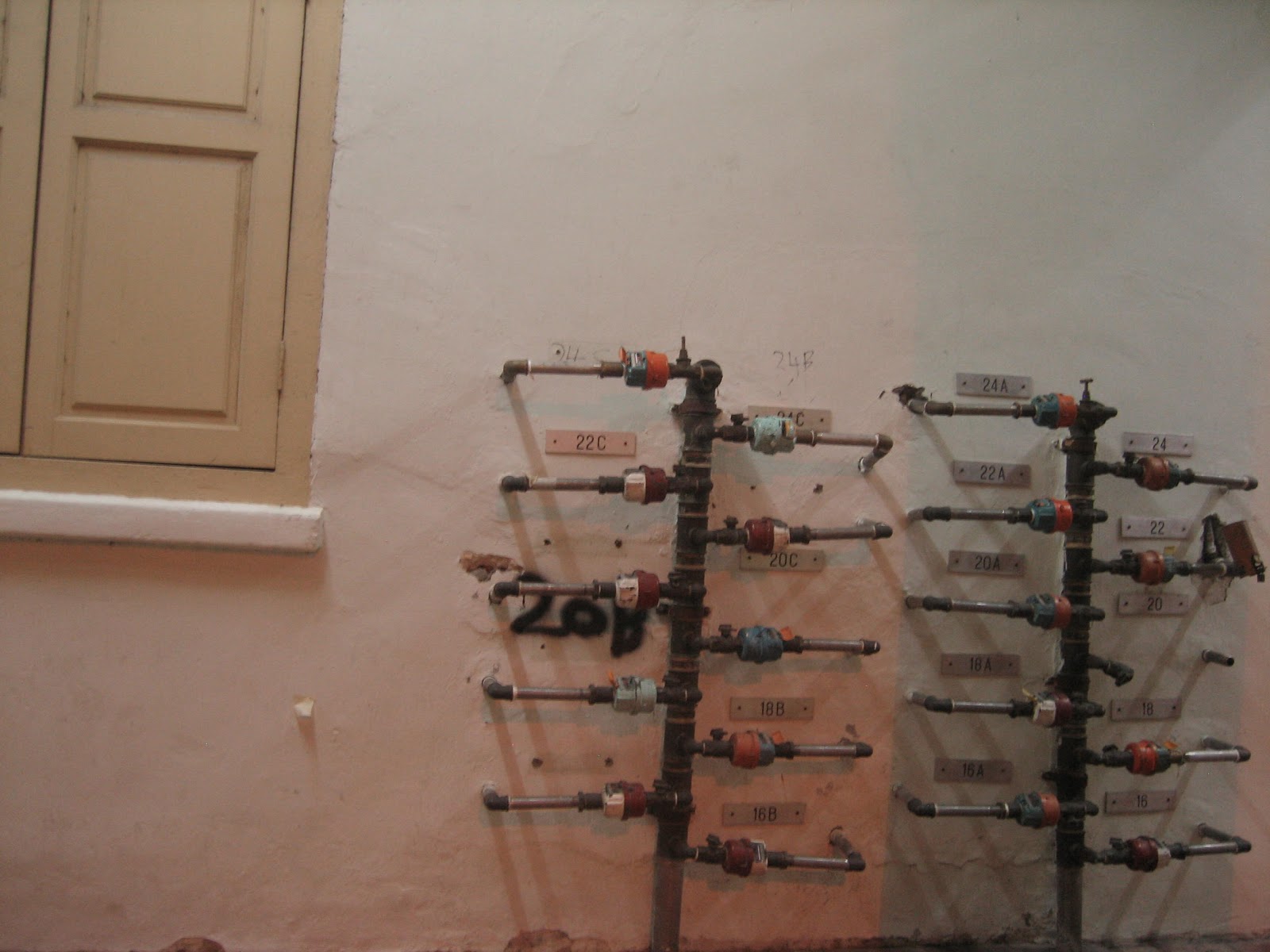

Economists like to speak of the invisible hand of the market.  I like to capture the works of the invisible hands of civil servants because they remind me of all that public health achieved while we were sleeping.  During this Smallpox Survival Season, I am thankful for all the answers public health has provided, like what number to call when my water heater goes up in flames.  And for answers to questions I hadn’t even thought to ask, like how hot should my tap water get?  I am thankful for all the taken-for-granted decisions I didn’t have to make, like having vaccinations for diseases whose symptoms I don’t ever need to learn.    

There are countless more public health problems we still don’t have solutions for, countless crises still overlooked by even the invisible hands.  Why, for example, are there enough many opiod pain relievers made to medicate every American 5mg of Vicodin every 4 hours for a month, yet hospitals have to ration their morphine supply?  Why are civilians allowed to possess assault weapons?  Why won’t providers see patients on public insurance?  For all these questions, I’m thankful that there will be jobs in public health policy for the foreseeable future.

What are you thankful for?

PS. The more I think about and edit this post, the more I realize I have to be thankful for: Nancy Turnbull, water fluoridation, and the brilliant Aussie minds behind Dumb Ways to Die.

Tuesday, September 25, 2012

Free Drugs 2: Escape from Copay Cove


Previously on Public Health Stories
I ate pastries of questionable origins.  Harvard researcher Dr. Dr. Niteesh Choudhry gave away heart medications for free.  The trial lasted about 2.5 years.  During that time, he threatened to fire me 31 times. 

So what happens when people get their medications for free?

(Drinking appears to be OK.  Isle of Skye, Scotland)
They take it!  Patients in the free drugs group adhered statistically significantly better by 4 to 6 percentage points.   

But not enough of it…  In the usual payment group, rates of adherence ranged from 35.9-49.0%, depending on the type of heart medication.  In the free group, adherence ranged from 41.5-55.2%, a big improvement, yes, but it also means that despite being offered free drugs, about half of the patients did not take advantage of these medicines essential to keep their hearts healthy and complication-free.

They stay just as healthy.  Patients who took the free drugs had fewer major heart complications than the usual payment patients.  But the difference was not significant (21.5% vs. 23.3%).  Patients in both groups generally performed the same when it came to the primary outcomes of interest (readmission for the first major heart problem), but when it came to certain secondary outcomes, patients in the free drug group had statistically significantly lower rates of major vascular events or revascularization.

They save lots of money.  Perhaps it was obvious that people getting drugs for free would have to spend less money on healthcare, but thinking of the whopping 30% they saved on overall drug spending and 18% on (non-drug) medical spending is pretty awesome when you consider that as more insurers adopt VBID (value-based insurance design, if you forgot from last week), you could be seeing these savings soon.

They don’t cost your arm and leg.  Despite the fact that the insurer had to foot the bill for free drugs, overall spending on the free group was actually 11% less than the usual payment group.  Insurers spent an extra 32% on drugs for the free drug group, but total spending for the free drug group was $66,008, compared to $71,778 for the usual payment group.  Though this difference of $5,770 is not statistically significant, the association is strong.  Getting better health quality (higher adherence) while saving patients money (free drugs) and not adding on the insurer’s total costs (i.e. other people’s free drugs won’t affect your premiums) is a rare and special win-win-draw in health policy.  So much so that the insurer is sticking with free medications for the time being.

Policy Implication: VBID can improve health quality without increasing costs. 

Full disclosure: Despite the generous things I said about him last week, I continue to work with Niteesh and believe in his greatness.  He continues to not coerce/pay me to promote him.  I am disappointed.

PS. If you’re smarter than I write and want to know more about the trial, I encourage you to check out the rationale and the primary analysis papers yourself. 


Tuesday, September 18, 2012

Free Drug Zone

Would you take your meds if they were free?  The idea of ‘free’ makes us a little loopy.  In Predictably Irrational, behavioral economist Dan Ariely suggests that free things compel many of us to make less rational choices, choosing the free gift card for $5, for example, when paying $2 for a $12 card is the better alternative.  During my master’s program, magic pastries used to appear in the computer lab lounge on paper plates, without any explanation but a handwritten sign that said “FREE.”  I knew nothing of where they came from, how long they had been out, and whether they were tainted.  I ate them because like Everest, they were there, and they were free.  
(This scorpion was free.  So I ate it.)
Given the special power of “free,” and what we already know about cost as an adherence barrier, Harvard researcher Dr. Dr. Niteesh Choudhry* set out to find what happens when people receive their medications for free.  Can we entice people to take their meds if they’re free?  Will that keep people healthier?  And how much will it all cost? 

The rationale behind Choudhry’s trial is a trendy health policy idea called “value-based insurance design” (cool kids say ‘VBID’) that got a special shout out in Healthcare Reform for its promises of improving healthcare quality and saving costs.  Under our traditional insurance system, the price you pay is partly determined by how much something costs, so the most expensive drugs are in the highest copayment tiers, regardless of how well they work.  Under VBID, copayments are determined by value rather than cost, so more effective therapies are cheaper than those without proven track records.  This pricing structure encourages consumers like you and me to spend our money on resources that are the most successful in keeping us healthy.

In Choudhry’s trial, patients who have had heart attacks were randomized to either receive heart medications their doctors prescribe at usual cost (whatever copayments they would usually pay) or for free.  Since these medications are well proven to prevent complications and prescribed almost universally when these patients are discharged from hospitals, this was a “high value” service that was made free to encourage patients to take their medications. 

So, how did it go?  Did patients buy into the free drugs?  Did it cost more than it was worth?  Oh look, I’ve run out of room.  You’ll have to stay tuned for Part 2 next week.  

*Making the rest of us look bad with an MD and PhD.

Full disclosure: I worked on this trial; it is the biggest study I have been a part of thus far.  Though I have a biased view of Niteesh’s greatness, he did not coerce/pay me to promote him.  He did, however, imply that I got hit by a Mack truck to get out of doing work for his trial.

Tuesday, September 11, 2012

Mistakes (Don't Have to) Happen

Part of how public health works "while we were sleeping" is to take away opportunities for making the wrong decisions.  Figuring out what decisions to target isn't always easy.  Banning cars will drastically reduce the number of car accidents on the road.  But it would also prevent people from giving me rides.  Public health succeeds then, when it strikes the right balance between what's good for the individual and the public.  Here are a couple of clever examples:

Haizhu Bridge

Maybe "clever" was too generous a term.  This wacky idea might not score an A in design, but it is reportedly successful.  If you're the officials of a crowded city with a growing bridge-jumping suicide problem, how might you combat an issue?  Making the bridge harder to jump off of is a good place to start.  The traditional approach is to put up barriers, but officials in Guangzhou had another idea: grease up the bridge with brown oils to make it difficult to climb.  Weird?  Yes. Unsightly?  Yes.   Effective in curbing the number of jumpers?  Also yes. 


Children's Aspirin*
This is one of my favorite stories of While We Were Sleeping.  In the 1940's, children's aspirin first came onto the market.  They were a commercial success.  Pink and flavored, they were attractive to children.  Some literally ate them “like candy” such that 200 children each year were dying from ingesting aspirin.  It took the work of a Duke pediatrician, Jay Arena, and the head of a small pharmaceutical company, Abe Plough, to stop these deaths.  They made the bottles more difficult for children to open.  Safety enclosures are routine for our pill caps now, but back then, no other company was willing to do so.  Plough took the risk.  “If it if it saves the life of one child," he said, "I’ll do it.”  They didn’t stop there.  Arena and Plough also worked to cut down the dose and number of tablets per bottle, so that even if all the other measures failed and a 2-year-old somehow ate an entire bottle of aspirin, the dose would not be toxic.   The child could still be safe simply because Arena and Plough adjusted the bottles. 

Policy Implication:  "It is possible to protect children without changing their or their parents' behavior.*"

*While We Were Sleeping pp 30-31, 37-39 (I swear I'll stop quoting DHem every other post.  But it's a hard habit to break.

P.S.  Those of you who like good long form non-fiction or want to read more about bridge jumpers, check out this excellent New Yorker piece on the Golden Gate Bridge.