Showing posts with label medications. Show all posts

Tuesday, September 25, 2012

Free Drugs 2: Escape from Copay Cove


Previously on Public Health Stories
I ate pastries of questionable origins.  Harvard researcher Dr. Dr. Niteesh Choudhry gave away heart medications for free.  The trial lasted about 2.5 years.  During that time, he threatened to fire me 31 times. 

So what happens when people get their medications for free?

(Drinking appears to be OK.  Isle of Skye, Scotland)
They take it!  Patients in the free drugs group adhered statistically significantly better by 4 to 6 percentage points.   

But not enough of it…  In the usual payment group, rates of adherence ranged from 35.9-49.0%, depending on the type of heart medication.  In the free group, adherence ranged from 41.5-55.2%, a big improvement, yes, but it also means that despite being offered free drugs, about half of the patients did not take advantage of these medicines essential to keep their hearts healthy and complication-free.

They stay just as healthy.  Patients who took the free drugs had fewer major heart complications than the usual payment patients.  But the difference was not significant (21.5% vs. 23.3%).  Patients in both groups generally performed the same when it came to the primary outcomes of interest (readmission for the first major heart problem), but when it came to certain secondary outcomes, patients in the free drug group had statistically significantly lower rates of major vascular events or revascularization.

They save lots of money.  Perhaps it was obvious that people getting drugs for free would have to spend less money on healthcare, but thinking of the whopping 30% they saved on overall drug spending and 18% on (non-drug) medical spending is pretty awesome when you consider that as more insurers adopt VBID (value-based insurance design, if you forgot from last week), you could be seeing these savings soon.

They don’t cost your arm and leg.  Despite the fact that the insurer had to foot the bill for free drugs, overall spending on the free group was actually 11% less than the usual payment group.  Insurers spent an extra 32% on drugs for the free drug group, but total spending for the free drug group was $66,008, compared to $71,778 for the usual payment group.  Though this difference of $5,770 is not statistically significant, the association is strong.  Getting better health quality (higher adherence) while saving patients money (free drugs) and not adding on the insurer’s total costs (i.e. other people’s free drugs won’t affect your premiums) is a rare and special win-win-draw in health policy.  So much so that the insurer is sticking with free medications for the time being.

Policy Implication: VBID can improve health quality without increasing costs. 

Full disclosure: Despite the generous things I said about him last week, I continue to work with Niteesh and believe in his greatness.  He continues to not coerce/pay me to promote him.  I am disappointed.

PS. If you’re smarter than I write and want to know more about the trial, I encourage you to check out the rationale and the primary analysis papers yourself. 


Tuesday, September 18, 2012

Free Drug Zone

Would you take your meds if they were free?  The idea of ‘free’ makes us a little loopy.  In Predictably Irrational, behavioral economist Dan Ariely suggests that free things compel many of us to make less rational choices, choosing the free gift card for $5, for example, when paying $2 for a $12 card is the better alternative.  During my master’s program, magic pastries used to appear in the computer lab lounge on paper plates, without any explanation but a handwritten sign that said “FREE.”  I knew nothing of where they came from, how long they had been out, and whether they were tainted.  I ate them because like Everest, they were there, and they were free.  
(This scorpion was free.  So I ate it.)
Given the special power of “free,” and what we already know about cost as an adherence barrier, Harvard researcher Dr. Dr. Niteesh Choudhry* set out to find what happens when people receive their medications for free.  Can we entice people to take their meds if they’re free?  Will that keep people healthier?  And how much will it all cost? 

The rationale behind Choudhry’s trial is a trendy health policy idea called “value-based insurance design” (cool kids say ‘VBID’) that got a special shout out in Healthcare Reform for its promises of improving healthcare quality and saving costs.  Under our traditional insurance system, the price you pay is partly determined by how much something costs, so the most expensive drugs are in the highest copayment tiers, regardless of how well they work.  Under VBID, copayments are determined by value rather than cost, so more effective therapies are cheaper than those without proven track records.  This pricing structure encourages consumers like you and me to spend our money on resources that are the most successful in keeping us healthy.

In Choudhry’s trial, patients who have had heart attacks were randomized to either receive heart medications their doctors prescribe at usual cost (whatever copayments they would usually pay) or for free.  Since these medications are well proven to prevent complications and prescribed almost universally when these patients are discharged from hospitals, this was a “high value” service that was made free to encourage patients to take their medications. 

So, how did it go?  Did patients buy into the free drugs?  Did it cost more than it was worth?  Oh look, I’ve run out of room.  You’ll have to stay tuned for Part 2 next week.  

*Making the rest of us look bad with an MD and PhD.

Full disclosure: I worked on this trial; it is the biggest study I have been a part of thus far.  Though I have a biased view of Niteesh’s greatness, he did not coerce/pay me to promote him.  He did, however, imply that I got hit by a Mack truck to get out of doing work for his trial.

Thursday, August 16, 2012

Not My Default


My parents were the type of ‘progressives’ who spanked their children but prefaced each punishment by asking us how many taps on the palm we thought our indiscretions deserved.  I felt it obvious to always start with ‘1’ and negotiate upward if necessary.  Peter's default, however, was ‘3.’  Because of this (and so many other reasons), he endured far more taps than I did.  Peter claims he was once told that he couldn’t start with 1.  I claim he’s simple. 

Policymakers use the behavioral economics of defaults to direct our behaviors.  Rather than constrain our choices, defaults capitalize on our readiness to accept the status quo.  Consumers could refuse a default, but most find it easier just to go along with it.  One oft-cited example of this is organ donor status. Countries like Spain, where organ donation is the default (and an ‘opt-out’ is required), have much higher participation than countries like the US, where an opt-in is required.  Automatic generic substitution is another good example.  

Generic substitution policies take advantage of what we’ve learned about the benefits of generic medications and the power of defaults.  The policies save payers and patients money by substituting prescribed brand name medications for bio-equivalent generics unless otherwise requested.  A 2010 study led by the brilliant Dr. Will Shrank* of Harvard Medical School examined the adoption of the new generic cholesterol drug simvastatin and its brand-name equivalent Zocor after Zocor’s patent expired in June 2006.  In comparing states that required patient consent to switch patients from Zocor to simvastatin (default no substitution) and those that did not (default generic substitution), the study found that default substitution states saved $15.35 per prescription in the first 3 months after patent expiration.  Of course, patient choice is also important.  The study reveals that after a year, the rates of generic adoption between states with and without consent laws converge, meaning that the majority of patients do eventually choose generic simvastatin, but those in states without default substitution took longer to choose simvastatin.  That time was costly.  Had the policies been in place and the wait averted, Medicaid could have saved $19.8 million on simvastatin alone.
 
The Red Line (default substitution) states had higher rates of generic adoption than the Blue Line (default no substitution) states.  The lines begin to converge in 2007, but the 5-quarter gap cost $19.8 million.

Policy Implication: Defaults can shape consumer behavior toward desired outcomes without compromising choice.  

*Disclaimer 1: I think Will is brilliant because I work with him and have personally witnessed his brilliance.  I am not paid to endorse him and do not speak for him.

*Disclaimer 2: In my younger, wilder days, I wrote a longer piece explaining the details of Will’s paper for a health advocacy blog.  You can find the post here.

Monday, August 6, 2012

They All Look the Same to Me


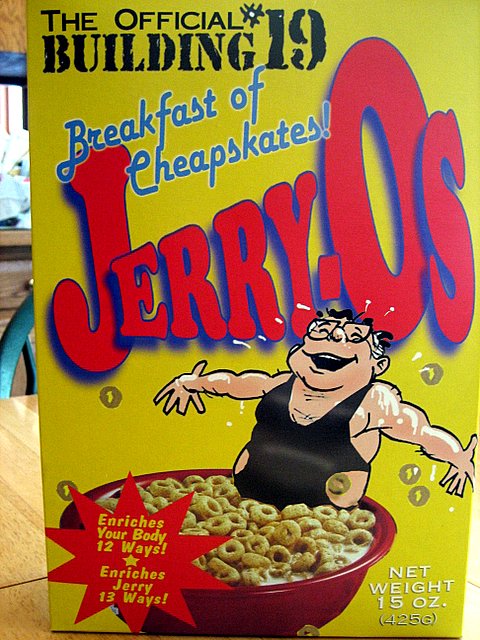
(Did your mother buy you "Official Building 19" cereal?  Mine did.)
I am about to start my second year of my second graduate degree ("20th grade").  Both of my parents went up to Grade 20 and beyond, quitting their jobs when I was five to go to graduate school for a second time.  So I am well acquainted with the lifestyle of the starving grad student.  I grew up eating generic brand cereal— the kind that come in bags rather than boxes and never with toys.  Even today, I often buy store-brand, though I do so begrudgingly (the same attitude applies to eating vegetables).  Generic cereals are powdery, ugly, and gross.  I much prefer my Kellogg’s Special K with Red Berries.  Yet when it comes to drugs, I always choose generic over Special K.

Remember how important it is to take your medications rather than flush them?  A major reason why people are non-adherent is because they can’t afford their medications.  About 1 in 4 American adults report taking less medications than prescribed to save money.  Since cost is a major barrier to adherence, promoting cheaper drugs is one way to improve patient adherence. 

Unlike store brand Plucky Charms, generic medications are cheap in price but not quality.  They only cost less than the brand name alternatives because the companies don’t have the same research & development costs branded manufacturers do.  In exchange for doing the legwork, branded manufacturers get unrivaled sales for about 10 years and set whatever price they want, making butt loads of money.  Generic drugs come on the market after the patent expires.  They are mandated by law to use the same ingredients and formula as their branded alternatives.  Plucky Charms aren’t mandated the same way.  Moreover, studies have demonstrated that generic medications are just as effective as branded drugs, even for classes of medications in which just a small difference can change how a drugs work— so called “narrow therapeutic index” drugs, like those for epilepsy.  Plucky Charms have not stood up to such rigorous testing.  Nobody should have to eat Plucky Charms.  But you should trust your generic drugs.  (And if you're still skeptical, we’ll talk about tricking you into trusting them in a future post).

Policy Implication: Generic drugs are cheap, effective solutions to cost-related underuse. 

Tuesday, July 17, 2012

Detailing Done Right

When it comes to sharing examples of good public health storytelling, I know that I should save the primo stuff for later to string you along, but I couldn't wait another week to share this, even if it means peaking too early.  It's hard to explain pharmaceutical detailing better than this classic Jon Stewart segment, with the usually sharp and funny Dr. Jerry Avorn playing the straight man.  Everything I know about pharmaceutical policy, I learned from working with Dr. Avorn's group.

PS. Got a tip for a good public health story?  Let me know so I can post it here.

Monday, July 16, 2012

Say Yes to the Drug


Growing up,  I was what the literature calls a 'non-adherent' or 'non-compliant' patient.  Rather than take my medications as prescribed, I often shared the wealth with the trash can and toilet.  One night, with my parents away and family friends babysitting, I issued a challenge.  Like that of a wary princess assessing her suitors, mine was simple:  I’d take a spoonful of medicine for every new Bible story they could muster.  My babysitters took the challenge with confidence.  They were, after all, seminarians—one formerly trained as a writer, the other a lawyer—and  I was just 6 years old.  “Have you heard the one?” they asked again and again.  Unfortunately for them, I knew all of Elisha’s miracles and Moses’ plagues from my parents, Sunday School and countless Super Book videos.  And those that I didn’t know—Dinah’s revenge, Hosea's family, Jeremiah's laments?  They realized that those were stories they weren’t ready to tell a 6-year-old.   That night, I went to bed victorious and un-medicated.

Non-adherence was not a particularly serious medical issue for me as an individual.  I got better and did not get anyone else sick.  But multiply non-adherence across all the other children, adults, and seniors who skip much more important medications for many other reasons-- not just because they don't like swallowing strange pills, but because of cost, forgetfulness, and lack of understanding-- and non-adherence becomes a public health problem.

Roughly half of all Americans who have had heart attacks do not take their medications as prescribed even though the evidence for the lifesaving potential of those drugs have long been proven.  Medication non-adherence means that the many health benefits of drugs that medical science has advanced cannot be realized.  It means that some patients who could've gotten better get sicker instead and their care gets more expensive for everyone, even you and me.  Put another way, medication adherence is one of those rare win-win-win medical issues where doing better benefits patients, insurers, and doctors (not to mention policy and drug makers).  An oft cited and sobering figure puts the annual cost of medication non-adherence in the US at $300 billion.  The number is far from perfect  and likely a gross overestimate (even the author acknowledges its limitations).  But it provides an easy and rough idea of just how big this issue is on both personal and population levels.  

This blog is  in its early days and I’m still laying down groundwork.  Stick with me through this and in the coming posts, you'll see a variety of neat health policy solutions to this very big problem.

Policy Implication: Non-adherence is a costly problem, in both health and expenditures,  for just about everyone involved.